
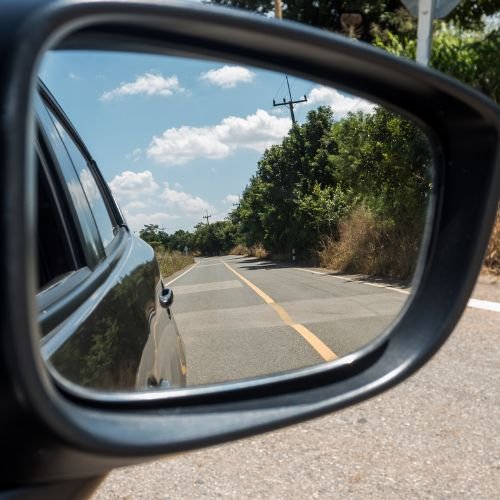
Side mirrors are essential to vehicle safety, giving drivers the visibility they need to see their surroundings.
A clipped side mirror doesn't always mean a new mirror assembly. Often only the glass needs replacing.
Knowing which one you need is the difference between a quick, inexpensive fix and a much bigger bill.
Quick answer: If the housing and motor are intact and only the glass is cracked, the glass alone can usually be replaced. Cracked housing, a failed motor, or a damaged mount means the full assembly.
First: What to Do Right Now
If your mirror is hanging by its wiring or flapping loose, handle it before you drive.
Don't let it dangle. It will swing into the door and damage the paint.
Tape it against the door with painter's tape or automotive tape. Avoid duct tape on paint.
Don't cut the wiring. Even a broken mirror's harness is part of the replacement job.
Collect the pieces if the housing broke apart. It helps identify the exact part.
Photograph it before cleanup if you're filing a claim.
Drive carefully and compensate with extra shoulder checks until it's replaced.
Glass Only, or the Whole Assembly?
This is the question that decides the cost, and most shops won't volunteer the answer.
Glass-only replacement works when:
The housing is intact and still firmly mounted
The mirror still adjusts normally
Heat, turn signal, and any camera still function
Only the reflective glass is cracked or shattered
You need the full assembly when:
The housing is cracked, dented, or detached
The mounting bracket or door contact point is damaged
The adjustment motor has failed
Wiring inside the assembly is damaged
The mirror won't hold position while driving
Send a photo with your year, make, model, and trim. We'll tell you which one you're looking at before anything gets ordered.
Why Your Two Mirrors Look Different
This isn't a manufacturing quirk. It's federal law.
Under FMVSS 111, the driver's side mirror on a passenger car must be flat — what the standard calls unit magnification. The passenger side is allowed to be curved.
Flat glass (driver's side): accurate distances, narrower field of view
Curved glass (passenger side): wider view, objects appear farther away than they are
That's exactly why only the passenger mirror carries the "objects in mirror are closer than they appear" marking.
Why it matters for a repair: replacement glass has to match what your vehicle came with. Flat glass on the passenger side costs you field of view. Curved glass on the driver's side distorts distance judgement.
SUVs, trucks, and vans fall under a separate provision and may use curved glass on both sides.
What Colorado Law Actually Requires
You'll see a lot of vague claims that driving with a broken side mirror is illegal. Here's what the statute says.
Colorado law (C.R.S. 42-4-226) requires your vehicle to have a mirror that shows you the road at least 200 feet behind you.
Exterior mirrors on both sides become mandatory when your rear view is blocked, including when:
The vehicle has no rear window
The rear window or rear side windows are obstructed or not transparent
You're towing a trailer or another vehicle
A load or cargo blocks the view behind you
A violation is a class B traffic infraction.
So the honest answer: if you drive a standard car with a clear rear window and a working interior mirror, losing one side mirror isn't automatically a citation. If you tow, haul, drive a van or a cargo vehicle, or have a blocked rear window, both exterior mirrors are required equipment.
Either way, you've lost blind-spot coverage that lane changes depend on. That's the better reason to fix it quickly.
This is general information, not legal advice.
Mirrors That Do More Than Reflect
Modern mirrors often house electronics, and that changes the part you need.
Heated glass for clearing frost
Turn signal repeaters in the housing
Blind-spot warning indicators in the glass
Auto-dimming glass on the driver's side
Puddle lamps underneath
Power folding motors
Cameras for surround-view or lane-watch systems
That last one matters most. If your mirror houses a camera, replacement may require ADAS calibration so the system reads distances correctly.
Trim level drives this more than model year. Two of the same car can take completely different mirrors.
Why This Isn't a Good DIY Job
Side mirror replacement goes wrong in predictable ways:
Door trim panels have hidden clips that snap if forced
Wiring connectors are fragile and specific to the vehicle
A mirror mounted slightly off vibrates at highway speed
Wrong glass curvature ruins your field of view
Camera-equipped mirrors may need calibration afterward
The part is often the cheaper half of the job. Getting the right part is the hard half.
Preventing the Next One
Most side mirror damage happens in the same handful of situations:
Tight garages and parking structures. Fold your mirrors in if your vehicle supports it.
Narrow residential streets. Parked-car strikes are common in older Denver neighbourhoods.
Mountain roads. Brush and rock walls catch mirrors on narrow stretches.
Hail and street parking. Covered parking helps more than anything else.
Winter ice. Never scrape mirror glass with a metal blade or pour hot water on it.
Check the mounting for play every few months. A mirror that has started to loosen will fail completely at the worst moment.
A damaged side mirror isn't always an expensive repair. Sometimes it's just the glass.
Take a photo, get your trim level, and ask the shop which part they're quoting. That one question can save you most of the cost.
Frequently Asked Questions
Can just the mirror glass be replaced?
Often yes. If the housing, mount, and motor are intact, the glass alone can usually be replaced.
How long does side mirror replacement take?
Usually 30 minutes to 2 hours. Glass-only jobs are often under an hour. Full assemblies with wiring take longer.
Is it illegal to drive with a broken side mirror in Colorado?
Not automatically. Colorado requires a mirror showing at least 200 feet to the rear. Both exterior mirrors are required when your rear view is blocked by cargo, a trailer, or an obstructed rear window.
Why is my passenger mirror curved and my driver's mirror flat?
Federal standard FMVSS 111 requires a flat driver's side mirror on passenger cars. The passenger side may be curved for a wider view, which is why it carries the warning marking.
Do camera mirrors need calibration after replacement?
If your vehicle uses a camera in the mirror housing for surround view or lane monitoring, it may. We confirm for your specific vehicle before the appointment.
Will insurance cover a side mirror?
Comprehensive coverage often applies to vandalism, hail, and debris damage. Collision coverage may apply after an accident. Your deductible may exceed the repair cost, so check first.
Quality Auto Glass Colorado is a family-run Colorado company. Our certified technicians handle side mirror repair and replacement, window regulator replacement, ADAS calibration, wiper blade replacement, and insurance claims support. Call (720) 863-0179.
